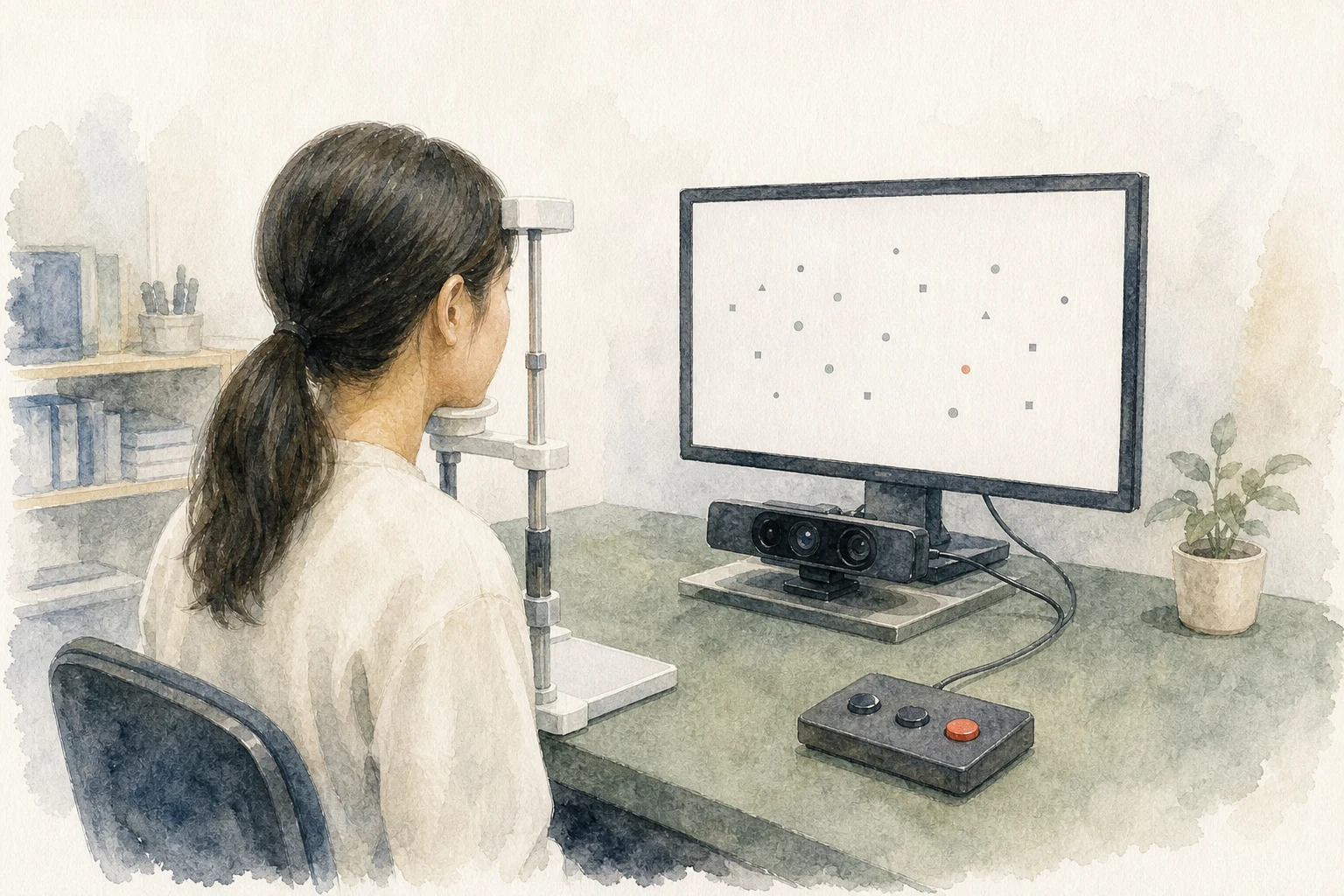
Our research asks how people select the visual information they need. We investigate visual attention and visual search, statistical learning of environmental regularities (including contextual cueing), decision making in visual foraging tasks, and how faces and social information shape perception and impressions. Our methods are behavioral experiments, eye tracking (EyeLink 1000), and online experiments.
EXPERIMENTAL SESSION
RESEARCH MAP
Selecting, learning, and evaluating are connected.
What is in front of you is searched within an environment and a context, and evaluated through what you have experienced before. That evaluation feeds back into what you look at and choose next. Our research asks where in this cycle information gets selected, and where judgments change.
CURRENT DIRECTIONS
What we are working on now, and where it is heading.
The three areas are scaffolding for sharing discussion and findings, not boundaries that limit topics. Work that crosses areas, or reaches beyond them, is part of the lab.
EDITORIAL IMAGE / NOT RESEARCH DATA
CURRENT DIRECTION 01
Faces and social evaluation
The impression a face makes is not determined by the image alone. In published work and undergraduate theses, we use morality, attractiveness, trustworthiness, and gaze as probes to ask where information about a person acts: on evaluation, on information acquisition, or on identification.
Regularities in the visual environment, and experience gained through past choices and rewards, persist in later search strategies. Across published work and theses we study attentional capture, learning, search, and selection history, asking when the effects of experience appear and how they are updated as the environment changes.
How seeing, experiencing, and being able to predict shape evaluation and choice. Starting from work showing a preference for predictable visual layouts, current projects (including undergraduate theses) address choice and preference, gaze and evaluation, processing fluency, multisensory information, and attitude formation through experience.
We do not treat methods as ends in themselves; they are chosen to test how perception and judgment work.
BEHAVIORAL EXPERIMENTS
Behavioral experiments
Reaction times, accuracy, ratings, and choices tell us how information is selected and turned into judgments.
EYE MOVEMENTS
Eye tracking
Measuring where, in what order, and for how long people look, to trace how search and attention unfold over time.
ONLINE EXPERIMENTS
Online experiments
Collecting data from diverse participants to test the conditions under which perception and judgment hold, and their individual differences.
EXPERIMENTAL DESIGN
Experimental design
Testing one hypothesis with different tasks and measures, and building experiments that leave no room for alternative explanations.
AI / IN DEVELOPMENT
A cross-cutting research program
Rethinking human vision through its differences from AI.
Generative AI and vision models learn regularities from massive experience to classify and generate. People also form habits of attention and choice through experience — but the two do not necessarily rely on the same information.
By experimentally creating situations where human and AI judgments diverge, rather than agree, we may be able to describe what is distinctive about human seeing and judging. We treat AI not merely as a substitute for people or a way to speed up research, but as a second system against which perception and judgment can be compared. This line of work is currently at the stage of shaping questions and methods.
WORK WITH US
Research areas are scaffolding, not boxes to assign topics to.
Research themes start from each member's own interests and questions. If your work addresses perception, attention, learning, or judgment empirically, you can reach us through graduate study, JSPS fellowships, or research collaboration — even if the link to the three areas above is not obvious.